INDIAN WELLS, CA, USA – Flashback five months ago. Casey Dellacqua and her doubles partner Yaroslava Shvedova had already qualified for the BNP Paribas WTA Finals Singapore presented by SC Global. They were the third team to do so, qualifying third behind Hingis/Mirza and Safarova/Mattek-Sands not long after reaching the US Open final. Then came the freak fall on court at the China Open that would sideline the affable Aussie with a concussion, forcing her out of the Australian summer swing.
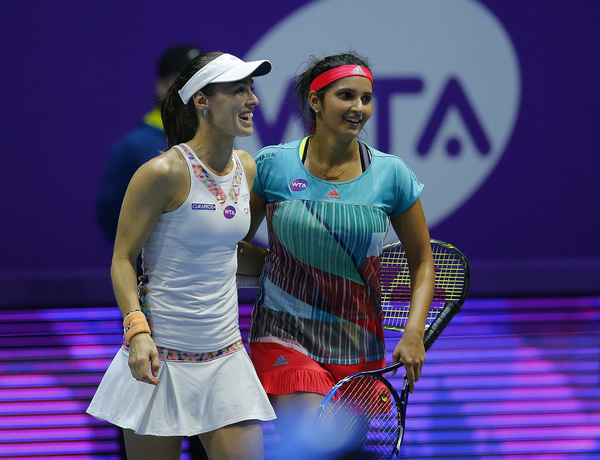
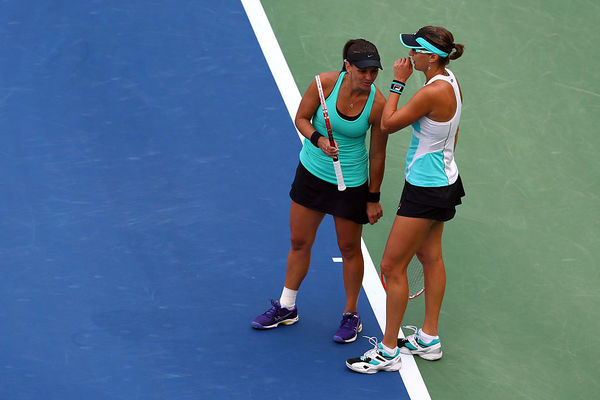
Still ranked No.4 in doubles, Dellacqua was cleared to play at the end of January and she returns to the tour this week at the BNP Paribas Open, playing doubles with her good friend, Sam Stosur. The quality pair have a mighty task against Co-No.1s Martina Hingis and Sania Mirza on Friday.
WTA Insider sat down with Dellacqua before the start of her tournament to talk about the difficulty of the last five months and how she hopes to get back on track.
WTA Insider: Can you just walk us through what happened in Beijing?
Dellacqua: I fell on court in the semifinals. I hit the back of my head and I kind of gave myself whiplash on the way down, so I had a lot of really bad neck pain, a lot of symptoms from the concussion, as well. It was a bit of a freak accident, really, and a bit of an unfortunate accident, because Slava and I had to miss the WTA Finals and had to miss a lot. Obviously, health is always a priority, but I suffered quite a lot from it.
I had symptoms like really, really bad headaches all the time. Any time I tried to do a little bit of exercise, I’d feel really dizzy and faint. I just was in a cloud of drowsiness. I couldn’t remember things, and I thought I’d be fine in a couple of weeks, but it actually got worse as time went on.
Then I just decided that my health was my priority, so this is my first tour event back. I played Fed Cup and played a 25K with Ash Barty a few weeks back. But this is my first WTA event back. It’s good to be back, but it did take a bit longer than I expected. It was just important, especially anything to do with the brain, that I was ready and fine to play again.

WTA Insider: Usually when a player is off tour it’s because of an injury that can be treated with surgeries, tape jobs, or medication. Concussions are a different beast. How do you actually “rehab” for a concussion?
Dellacqua: It’s just time, and that was a real frustrating thing. I’d keep saying, ‘I’m fine, I’m fine,’ and I kept doing all these tests with my doctor back home, and she was just ruling me out. It was up to her, really, in the end because it’s a bit negligent if they send me out there when I haven’t passed all the tests that needed to be done.
It was a really frustrating injury because I’ve obvious had a couple of big injuries before but yeah, you do rehab. This was really frustrating because I didn’t have a timeframe, and it was just about making sure that you’re healthy, and it’s hard to know when that is. It was kind of frustrating in that sense, and there wasn’t much I could do, except rest.
They just said it’s kind of like spraining your ankle, only you’ve sprained your brain a bit, and you need to let it settle. I thought I was losing the plot there for a while, because the brain’s so important; it controls everything. So I did think for a bit I was losing the plot, but I’m good now and they kept reassuring me that I was going to be fine and it’s just time.
WTA Insider: Since you didn’t have a timeframe on when you might be cleared to play, was there ever a time you thought your career might be over?
Dellacqua: I guess that was really frustrating because I’d had a really good year, as well. I just wanted to get back out there but then you start to doubt yourself, like, ‘I’ve had a couple of big injuries, I’m 31 in February,’ and the longer I’m out, the harder it is to get back. You start stressing, and that’s not going to help. I was having trouble sleeping, and it was just a vicious cycle.
It was really important for me to kind of just step away and make sure I got better because I certainly had doubts of like, ‘When am I going to feel right to get back out there?’ That stress of knowing the longer you are out, the harder it is. These girls are getting better, they’re faster, they’re stronger and one month is big. That was frustrating, as well.
At the moment, I am just going to focus a bit more on doubles. I do still want to play singles, but I’m probably still not right just yet to play both and manage that. I’ll play a bit of doubles just to get me back going, and look to play a bit more singles, but I’m just glad to be healthy.
WTA Insider: When did you get the all-clear?
Dellacqua: I went down to Melbourne for the Australian Open, and I was doing a little bit of a hit with Alicia Molik, the Fed Cup captain. I said, ‘Look, the doctor said that I was fine,’ and I’d done a little bit of physical activity and felt that I recovered ok.
Alicia was kind of like, ‘Do you think you’ll be ready for Fed Cup?’ and I was like, ‘Well, you tell me; I’ll practice and I’ll give you what I’ve got. If you think that’s good enough, then yes, I’m ready.’ I did some work down there, and did some doubles stuff with Cara Black, which was great, and went to Fed Cup. Just before Fed Cup, they kind of said that I was good.

WTA Insider: Were you able to do any training while you were still suffering from the concussion symptoms?
Dellacqua: The first couple of months, I was actually just resting a lot at home. Any time I’d even try to do grocery shopping, for example, or do things with [my son] Blake, I’d just get really headachy. For the first few months, I really didn’t do much, I was just at home recovering. I couldn’t even watch movies, so I was at home and it was frustrating. Any time I’d watch TV for 10 minutes, I’d get a headache.
I knew when I came back that I was going to have to work hard again. That’s why I’m just training, playing some doubles, and then increasing my load. I can’t go from doing that to doing a lot, because I’ll get injured again. I’m just trying to find a good balance of increasing my load, slowly, and making sure that I’m healthy along the way.
WTA Insider: Were you surprised you were able to win your first match back at Fed Cup and then make an ITF final with Ashleigh Barty?
Dellacqua: The Fed Cup was really crucial in the end, because we had to play a live rubber, and I hadn’t played a match since October, so I was like, ‘Way to throw me in the deep end!’
I was just really stoked because Sam was playing well; she’d won both her singles and I felt comfortable walking out there with here. We’ve known each other for a long time, so it was comforting to know that I could talk to her and just say like, ‘You’ve got to help me out; I haven’t played a match for a while.’ That was great; the Fed Cup gave me a lot of confidence to know that, ‘Ok, I haven’t played for four months, but I’m still ok.’ We played, and we won, and it was a pretty crucial match.
Then going to the ITF was great; we made the final. I didn’t know really what to expect. Ash hasn’t played for 18 months, I haven’t played for a bit. I just wanted to get consecutive matches. We made the final. I felt better then, coming here, knowing that I’ve played a few matches, as well. I think so far so good, and see how the year unfolds. So far, I’m good.
WTA Insider: Are these weeks in Indian Wells just an experiment to see where you’re at and then you’ll re-assess? Or do you have a schedule mapped out?
Dellacqua: I’m definitely going to play The Miami Open and Volvo Cars Open in Charleston, for sure. Then we’ve got another Fed Cup tie in Australia against America.
I’m pretty much ready to go. I’m just not sure when my singles will kick back in. I really want to try and really be ready for the grass circuit. When I can play singles – because my ranking’s at No.150 – when I can get in, I want to play now, but it’s going to be tough that my doubles ranking is higher. I’m just going to try to work it out and see where it goes.
WTA Insider: Usually players keep their off-day training light during tournaments. Are you continuing to train while you’re playing?
Dellacqua: If I was in tournament mode, I’d probably do a bit less than I have been doing. I’ve even been playing some singles points, in preparation for singles. I’ve just got a little bit more stuff to do in the gym, because I am just playing doubles and at these tournaments, you have a fair bit of time, sometimes, to have practice days.
It’s kind of a little bit like my pre-season as such, because I didn’t really do one. That and getting back into some point play. Anyone I practice with, I’m doing a lot more singles, actually. I’ve played a bit of practice doubles, but I’ve been doing more singles [practice].
WTA Insider: Is your family able to travel with you?
Dellacqua: [My partner] Amanda’s pregnant again, so she’s 30 weeks. She’s too far along to travel, so she’s due in early May. Unfortunately, Blake couldn’t come. When I get home from Fed Cup – it’ll only be a few weeks – and then the next baby will be here. It’s going to be busy, but that’s why they couldn’t travel this time around.
Life’s about to get a bit more crazy, but that was a positive [from the concussion]. Obviously being out, I got to spend a lot of time at home with Blake, and help Amanda out, being pregnant, so that was great that I could give her a helping hand as well.
WTA Insider: So how does it feel to be back on tour?
Dellacqua: It’s pretty much same old, same old. It’s just the crazy tennis world. Nothing’s really changed too much; there’s a few new faces, actually, some girls that may have done well through the end of last year that I maybe haven’t seen, or maybe over the Australian Open. But there’s always girls coming up the ranks, playing better.
There’s still all of the other girls still playing, so not too much has changed. Because the only stuff I’ve missed was the Aussie Open and the pre-season, everything else was pretty much wrapped up, so I haven’t felt like I missed out on a big chunk of tournaments. I’ve only really missed the Aussie summer. In that sense, I think that’s good too.
All photos courtesy of Getty Images.